Awd Wheel Drive
All-wheel drive (AWD) is a vehicle drivetrain system in which all four wheels receive optimal power as needed . AWD informs how a vehicle’s wheels receive power, particularly in the face of harsh weather, challenging terrains, and a variety
SH-AWD is unique in that it can send 70% of the engine power to the rear wheels. There are two kinds of all-wheel-drive systems: full-time and part-time. Full-time AWD continuously motivates all four wheels. Part-time AWD usually remains in front-wheel-drive (FWD) or rear-wheel drive (RWD) mode until more traction becomes necessary.
Read on to help decide which drivetrain best fits your needs. AWD is a system primarily engineered for on-road use . In its purest form, it sends engine torque to all four wheels simultaneously.
All Wheel Drive vs. 4 Wheel Drive: What's the Difference? - AWD vs 4WD
If you're shopping for a new vehicle in the Charleston area, you may have come across the term "AWD" and wondered what it means. AWD stands for all-wheel drive, a drivetrain system that powers all four wheels of a vehicle simultaneously for maximum traction .
All-Wheel Drive (AWD) is a system where the engine sends power to all four wheels all the time , having advantages in traction and cold weather.
The wheels are driven, but not dependent on a central mechanical power coupling. Particularly in North America for several decades, the designation AWD has been used and marketed – distinctly from 4×4 and 4WD – to apply to vehicles with drive train systems that have permanent drive, a differential between the front and rear drive shafts, and active management of torque transfer, especially following the advent of the anti-lock braking system (ABS).
All-wheel-drive systems power both the front and rear wheels all the time. But in practice, there are actually two types of drivetrains that are called AWD. One drives all of the wheels continuously, and some manufacturers refer to this as full-time AWD.
Two-wheel drive (2WD) means that only one axle of the car—either front or rear—puts the car’s power to the ground. With all-wheel drive (AWD) and four-wheel drive (4WD), all four tires can drive the car. If you’re looking for maximum grip, we’ve found that all- and four-wheel-drive systems provide superior traction in some slippery conditions.
Rear-wheel-drive cars offer a better drive, a high level of grip on bends and greater steering control, with excellent traction on acceleration. However, RWD makes the car harder to control if you spin due to oversteer, it is more expensive to buy and maintain, and the friction increases fuel consumption. AWD and 4WD cars offer better control in difficult road conditions, excellent grip on acceleration and a higher level of safety.
All-Wheel Drive (AWD) is almost the same as full-time Four-Wheel Drive (4WD). It is also a system that powers all four wheels of a vehicle at all times . It can be used full-time on all surfaces, including pavement, like full-time 4WD. The only difference is that a "4-low" setting is not available
Most AWD vehicles, as well as RWD vehicles with front-mounted engines, need to extend the drivetrain from the front to the rear of the vehicle. Since there’s only so much space underneath, space must be taken from the cabin. If you’ve ever been in the backseat of a vehicle with a hump or tunnel that intrudes from the floor and runs down the middle of the cabin from the front to the back, it was likely accommodating rear- or all-wheel-drive infrastructure.
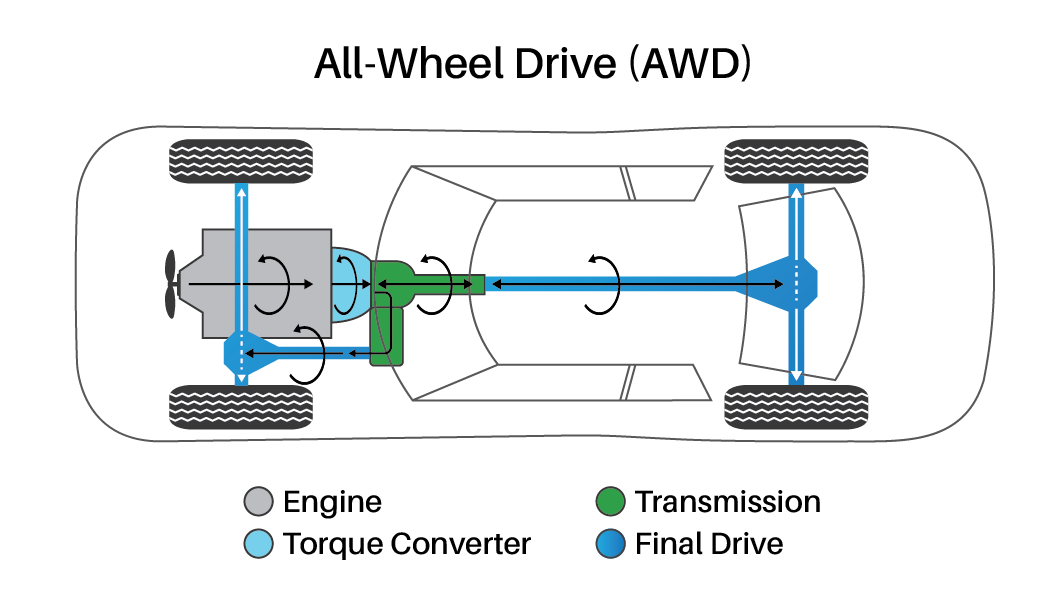
All Wheel Drive (AWD): How It Works, Benefits, and When You Need It ...

Types of four-wheel drive (4WD) and all-wheel drive (AWD) systems – x ...

4-Wheel Drive (4WD) vs. All-Wheel Drive (AWD) – x-engineer.org
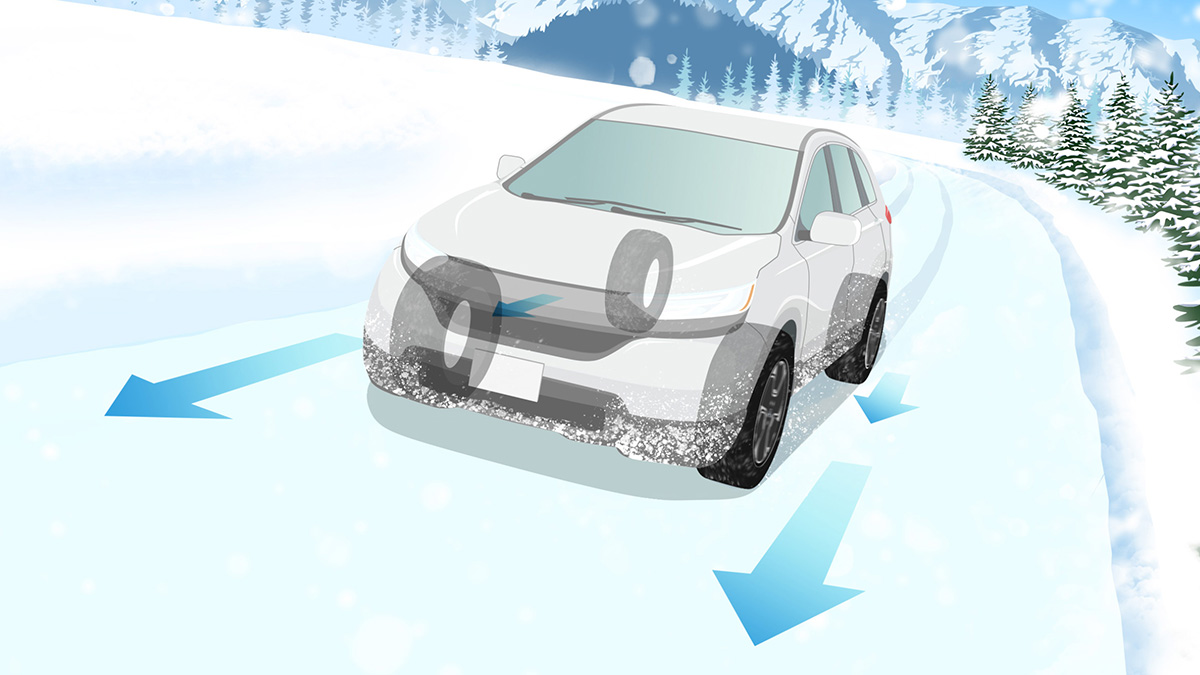
All-Wheel Drive System Real Time AWD | Honda Technology | Honda
In normal operation, part-time AWD sends torque to two driven wheels, either the front or rear, depending on the vehicle. The part-time system then automatically engages the other wheels when road conditions demand extra traction. Modern part-time AWD uses an array of electronic sensors that feed information to a computer, which controls the amount of power directed to each wheel.
All-Wheel Drive (AWD): AWD is designed to automatically send power to all four wheels of the vehicle when needed . It’s mostly used for everyday driving on paved roads, especially in conditions like rain, snow, or ice.
While espresso and all-wheel drive are acceptable for everyday use, Irish coffee and four-wheel drive should be reserved for more special occasions (though never at the same time), the times when you really need something with an extra bit of strength. And to clear things up, the term 4x4 is synonymous with 4WD, much as 2x4 is analogous to two-wheel drive (2WD). AWD is optimized for on-road use.
The terms all-wheel drive and four-wheel drive are often used interchangeably, although there is a difference. AWD is mainly for use on the road, while 4WD is better suited for off-road applications. Typically, heavy-duty SUVs and pickup trucks have 4WD systems.
Honda AWD (All-Wheel Drive) optimizes distribution of driving force to all four wheels to offer more secure and enjoyable driving than standard two-wheel drive . First introduced in February 2018, the latest version of Real Time AWD takes four-wheel
All-Wheel Drive (AWD) has become a popular choice for many reasons, including its versatility and ability to anticipate and adapt to changing road conditions, by sending power to all four wheels, or just two.
If you live somewhere with a lot of rain or snow, or if you want to drive off-road, you’re probably considering an all-wheel-drive (AWD) or four-wheel-drive (4WD or 4x4) vehicle. Both have an advantage over two-wheel-drive vehicles when it comes to driving in wintry conditions or on dirt because both send power from the engine to all four wheels. Published January 24, 2023
For more information, click the button below.
Tags

Sonya
Impulsionado pelo compromisso com a educação no ambiente escolar, construí minha trajetória com o objetivo de ampliar as oportunidades de aprendizagem e gerar impactos positivos para estudantes, educadores e comunidades escolares. Ao articular princípios pedagógicos, experiência cotidiana em sala de aula e diálogo contínuo, desenvolvo práticas educacionais inovadoras, inclusivas e aplicáveis, que respeitam a diversidade dos modos de aprender e respondem às necessidades reais da escola - shop.forgiato.com.
